
Fury of Firestorm Issue 1 is published by DC Comics and written by Jeff Lemire, with art by Rafael De Latorre, colors by Marcelo Maiolo, and letters by Lucas Gattoni.
Firestorm touches down in a small rural area, causing enough devastation that an old flame is called in.
This issue adopts a strange yet fascinating tone from the beginning. Fury of Firestorm Issue 1 is a slow-burning horror with startling moments of destruction. The opening pages are so alarming and brazen in the death toll that it’s easy to believe it’s a dream sequence or a sign of things to come. But instead, it’s the truth, and an inciting incident that demands a response. There’s a terrifying quiet throughout this opening, as uncertainty about what Firestorm is and who controls him grows.
Firestorm is a hybrid consciousness that fuses two minds into a single body. Usually, that contains high school athlete Ronnie Raymond and genius scientist Martin Stein. But there are other minds that can be added into the matrix. There’s a fantastic transition between the scenes because the middle of the comic features not just a time skip but also a shift in tone.
Fury of Firestorm Issue 1 becomes a classic comic story, reminiscent of original Firestorm issues. That is before the book drops again, getting even darker and more intense. Every part of the book is a surprise after the shocking start, with the rest of the pages getting gradually more ominous.
Fury of Firestorm Issue 1 is unique because the main character and the book’s heart aren’t there. Firestorm is the threat, the danger. The narration at the start is from the third person, describing the events like the bible, which makes Firestorm seem even more inhuman. With what he does, readers feel cold and afraid, too.
Despite not having Firestorm to provide dialogue, Lemire superbly explains the character’s background and powers. The comic puts the focus on Firehawk, Ronnie’s ex-girlfriend. A metahuman herself, she becomes the anchor point within Fury of Firestorm Issue 1, experiencing everything first-hand. She knows Firestorm and recognizes when something isn’t right.
Both personalities that typically make up the matrix do actually make an appearance during the scene that feels like a comic from ages ago. This provides a great context for what the hero is usually like. Ronnie, with his boisterous, youthful exuberance, and Stein, with a more studious, careful approach. It makes it all the more disturbing when the Firestorm that Firehawk and the military encounter is so quiet, oppressive, and scary. There’s another voice within the matrix.
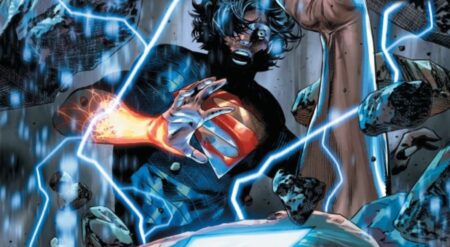
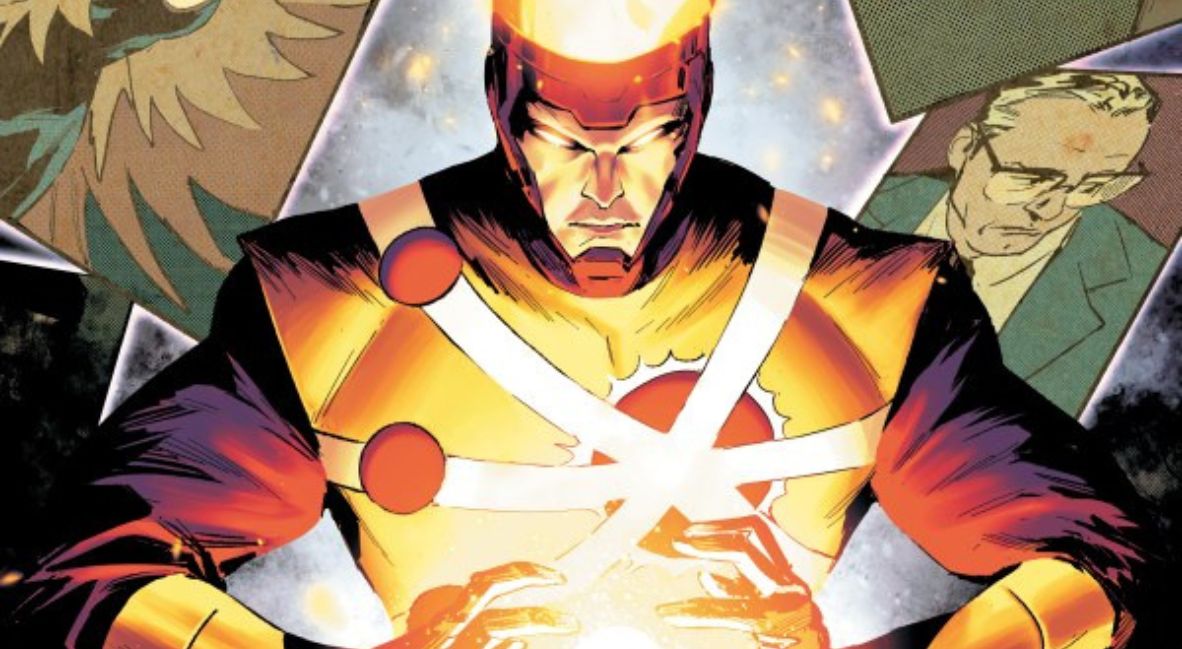
The art separates Firestorm from everyone else. De Latorre makes the nuclear man look like a god. Firestorm may look like his powers are focused on fire, but he’s actually based on fusion and molecules. His main power is transmutation, turning objects into other things. He can control their density and turn solid objects into liquids or gases.
And usually, Firestorm avoids using this power on humans, but they can if they want. What is unleashed is a selection of horrifying experiments, like playing with a chemistry set where the other subjects are unconsenting humans. It’s a haunting display of power, so casually emitted.
The design of Firestorm hasn’t changed much at all; it’s very iconic and instantly recognizable. He should be looked up to and inspiring, with the visage of one of DC’s most important heroes within a small, unassuming town. But there’s another feature, eyes without pupils, which makes them emotionless and sinister.
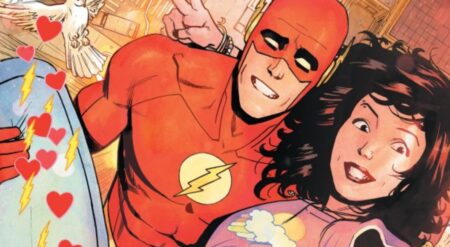
The middle section of Fury of Firestorm Issue 1 transforms the issue. It reflects a silver age approach to superheroes. The sky is clear; Firestorm has much more movement and energy, and his face is expressive. That’s how he’s remembered, before something takes the matrix down a dark road. This is evident when the happier scene devolves into the most horror-adjacent part of the comic.
The colors are sensational, absolutely unreal in the atmosphere. Firestorm’s suit and powers are immensely vibrant, with red and yellow making up the flames and fabric of his clothes. In the opening, the times around him are beige, but there’s also a slight, radioactive green around him as things begin to change. The lettering is very clear and easy to read.
Fury of Firestorm Issue 1 realizes a nightmare. Jeff Lemire explores what would happen if one of the most powerful heroes in the DC Universe became corrupted. It has horrifying consequences, displaying powers usually used for good that suddenly turn to horror. Both Lemire and the art team use storytelling devices specific to comic book storytelling, exclusive to the medium. The change in style highlights the passage of time across generations, evolving into something new whilst celebrating the past.
Fury of Firestorm Issue 1 is available where comics are sold.
Fury of Firestorm Issue 1
TL;DR
Fury of Firestorm Issue 1 realizes a nightmare. Jeff Lemire explores what would happen if one of the most powerful heroes in the DC Universe became corrupted.