
The 2026 Sundance Film Festival’s Midnighters section was stacked with societal horror films that delved into different cultural aspects of fear. From motherhood in Undertone to conversion therapy in Leviticus, that was the selection’s defining feature. And with the opening Midnighter, Saccharine (2026), we received a body horror film that looked at the body, the way that women do, in all of its dysmorphia-fueled distortion.
An eating-disorder horror, for lack of a better descriptor, writer-director Natalie Erika James uses the same powerful view that gave audiences the Relic (another Sundance premiere) to embrace the current Ozempic moment of body negativity in Saccharine (2026). Through grotesque body horror and moments of unseen tension, Saccharine doesn’t just tackle a moment; it tackles its audience.
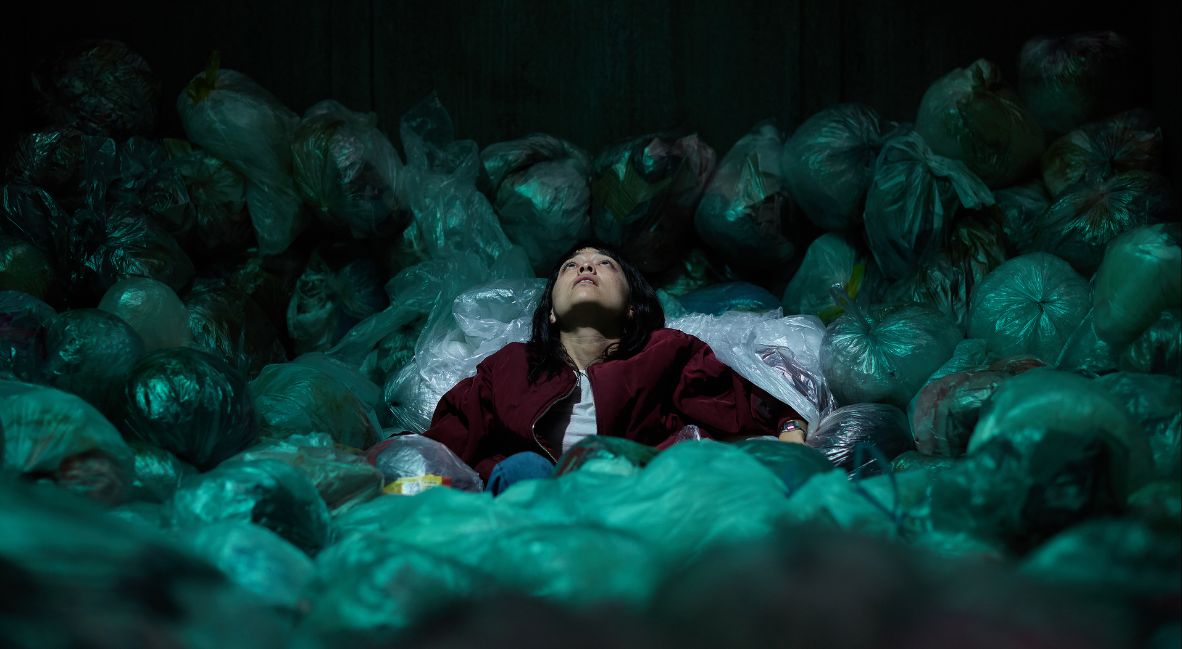
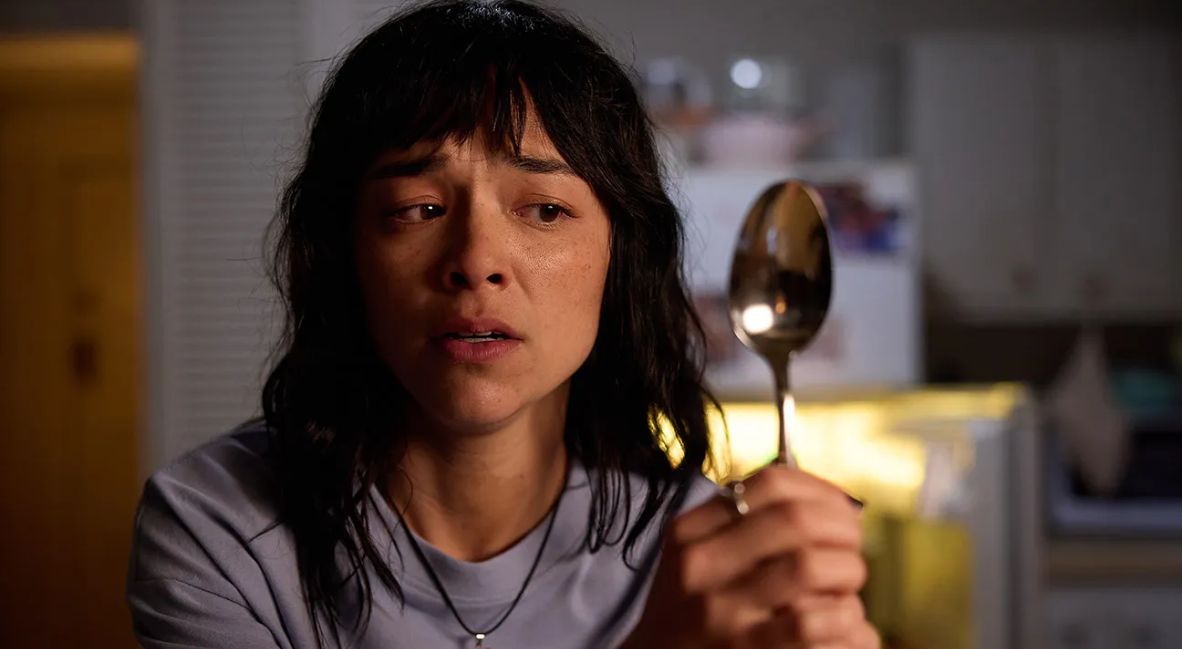
In the film, Hana (Midori Francis) is a lonely medical student who just wants to lose weight. We meet Hana mid-binge, only for her to dump the food in the garbage and squirt dish soap on it to avoid continuing to eat it (a very real part of some people’s binging). She doesn’t have a girlfriend, she doesn’t have a great family life, and ultimately, she just wants a body she can feel proud of, while everything else in her life is empty.
When Hana meets an old friend from high school who has undergone a massive transformation due to weight loss, she learns about a new drug: gray. One pill, once a day, and the calories just don’t matter. The only catch is that she doesn’t have enough money to pay the insane price. But Hana has access to everything she needs to find out what’s inside them and make her own version of the pill; all she needs is human ashes.
Initially, following the same weight loss path as her old classmate, the ashes are doing the job. She can eat anything, and nothing sticks. But with the scale ticking down, strange things start to happen as a hungry ghost begins to take over Hana’s life. First, it’s small things, waking up with the trash of a binge in front of her, hearing footsteps in the house. Then it escalates, damaging her life and relationships, and the hungry ghost manifests constantly. Soon, Hana has to worry whether she will survive.
Natalie Erika James’s body-horror take on weight loss captures the moment.
It has taken me a long time to write a review for a film I saw the first night of Sundance, but the reality is that Natalie Erika James’s film is a mirror for me. I battled an eating disorder for most of my life, and getting better is something that I chose to do every day, and in a way, I still do. It’s a topic I’ve written about at length, but the difficulty of letting go of control is something films about beauty don’t entirely focus on.
Saccharine (2026) isn’t just about how Hana is on a vain quest for thinness. As the film unfolds, you start to see all the broken parts of Hana, and how each jagged edge that sticks out when she tries to fix it becomes just another reason to stay in control. It’s a snowball when you’re in it.
You notice you need help, you try, and as you work on fixing yourself, something new pops up, pushing you to try and stay in control at least one more time. Watching Saccharine (2026) in a theater, the day I arrived at the fest after spending an hour packing, and panicked because the winter clothes I wore the previous year didn’t fit, hit like a ton of bricks.
Much of my praise for Saccharine (2026) comes from how Natalie Erika James captures that when restricting your food or binging is about control, and how accurately she depicts the bottomless it all becomes. You will never restrict enough, you will never eat enough, and having lived with both overeating and eventually bulimia, the emptiness that both create in your course is too much to handle.
But director James didn’t create a body-horror film about weightloss to fit my eating disorders at their height. She made it in conversation with the current GLP-1-focused approach to “health” is recreating the dangerous heroine chic of the early aughts. Only now, that thinness and massive weight loss are considered healthy regardless of the circumstances, and how it impacts mental health.
Visually, the use of fat suits and make-up can come across as too much, but ultimately, both the ghost haunting her and Hana are suffering the same. While the suits are a crucial element of special effects work in Saccharine (2026), the film’s real moments of unsettling work come in its third act.
Saccharine (2026) is an eating disorder horror story that doesn’t try to keep its audience comfortable
As Hana’s haunting continues to push her into a corner, causing her to keep binging and lose weight in the process, she attempts to stop it. Only the ghost won’t be stopped. In one scene, the ghost begins to crawl up Hana’s body, causing her body to compress under the weight. We’ve seen this trick on Hana’s bed, or heard it through footsteps, but here, we see Hana’s body start to bend, and we can’t help but brace for the moment it breaks. The special effects are the star of the third act when Saccharine (2026)‘s body horror reaches its apex.
The important thing, however, isn’t the shocking nature of the body horror or the bodies on screen. If you sit in this audience after over 15 years of an eating disorder, everything that Hana is experiencing washes over you. You want her to break the feeling; you want her to stop taking the grey, and, like Hana, you’ll be confused as to why she can’t stop it, even once she stops the actions and rituals.
Then, it all clicks into place. No matter what, Hana hasn’t dealt with why she wants to control her weight. And when it comes to love, Hana hasn’t tackled the question: do you want to be your gym crush, Alanya (Madeleine Madden) or be with her?
Hana is lonely, and that loneliness is festering because she hasn’t dealt with her childhood trauma, from parents who show their love by either starving or feeding their kid. Hana has not healed mentally, just physically. She’s just accepted that the gray was a bad idea.
Saccharine (2026) offers no big crescendo of Hana understanding how she got into the situation. Even her friend, who has consistently reassured her that her weight doesn’t matter, hasn’t dealt with the real issue. And ultimately, as Hana settles in to have a relationship with her gym crush, she is just trying to love her way into health. If she has someone else accept her, then she doesn’t have to accept herself.
The heartbreaking element of Saccharine (2026) is that eating disorders aren’t ever really something that you heal from. You get better, and you live with it, and you stop binging and purging or starving. But it still haunts you. Now in my mid-30s, I want to say that I am okay.
I want to say that I don’t think about what I’m eating or fight the urge to throw up after a massive meal that I ate out of stress. There are relapses sprinkled in between the 12 years of recovery I have been in, but ultimately, I will never be who I was before it, and I can’t fake that I am.
Saccharine (2026)’s main point is that getting better isn’t superficial.
As Saccharine (2026) comes to a close, Natalie Erika James forces her audience to see that in Hana. No matter the love in your life, that alone will not fix you. Much like the Netflix drama, To The Bone, which focused on a woman in recovery from anorexia, there isn’t a switch to flip to be better, even when you’re racked with guilt for the people you hurt. You have to want to be better, and you have to work to mend what’s broken, but that comes through talking about it, not trying to escape it.
I have sat with Saccharine (2026) for almost two weeks, and in its horror, Natalie Erika James created one of the most gutting reflections of myself, and I know I am not alone. It’s tough to watch Saccharine (2026), and I am sure those who don’t struggle with anything related to eating disorders may look at some elements as distasteful.
For me, it was seeing myself in a film. It was the struggle I have knowing that losing weight with medication for my health, even when prescribed by my primary doctor, is a slope I have to manage carefully. It’s the fear of letting one pill in my life push me back over a ledge I tried so hard to step away from. My life is every bit as haunted as Hana’s is, and that’s the sad truth.
Saccharine (2026) won’t find an audience with everyone, but for those who see themselves, they’ll feel anger, shame, sadness, and hopefully, catharsis. I know I did, and in the end, that’s what cinema is all about.
Saccharine (2026) premiered at the 2026 Sundance Film Festival. It will have its theatrical release later in 2026.
Saccharine (2026)
-
Rating - 8/108/10
TL;DR
Saccharine (2026) won’t find an audience with everyone, but for those who see themselves, they’ll feel anger, shame, sadness, and hopefully, catharsis. I know I did, and in the end, that’s what cinema is all about.