If “Kids These Days” is about rupture, Star Trek Starfleet Academy Episode 2 is about rebuilding; quietly, deliberately, and without the safety net of spectacle. “Beta Test” is a stronger episode largely because it resists the modern Star Trek instinct to prove itself through action. Instead, it lets politics, culture, and character do the work, clarifying what this series actually wants to be. This is the most Star Trek the series has felt so far, not because it’s nostalgic, but because it’s willing to let conversations carry weight.
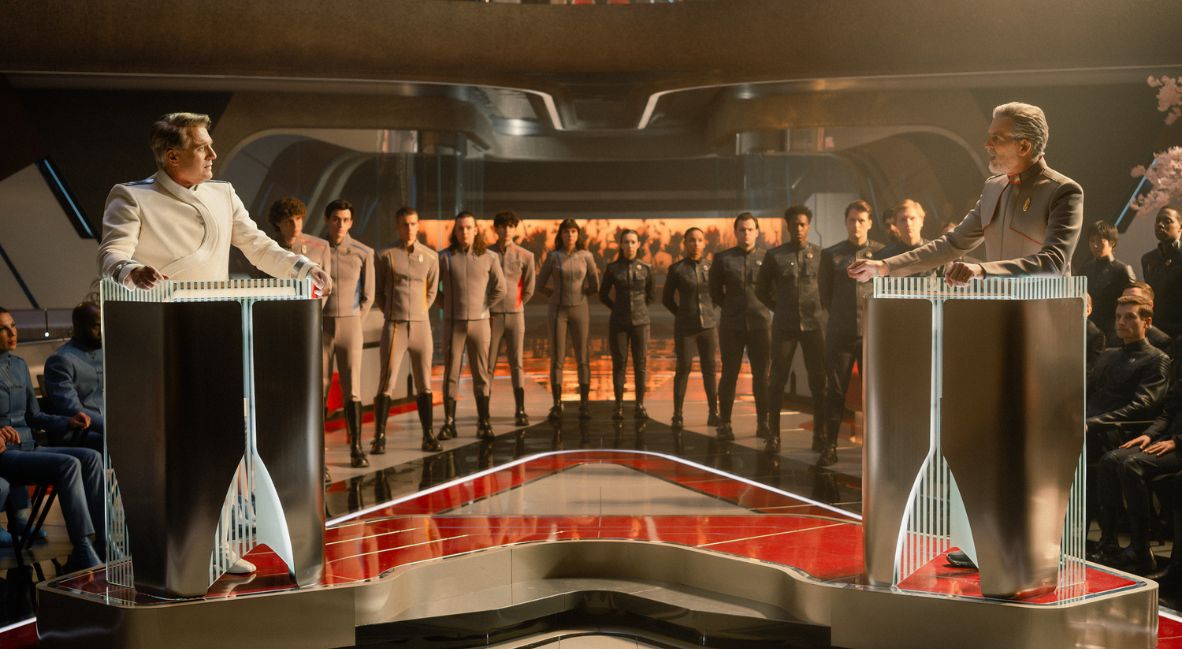
That weight comes through immediately in the contrast between Starfleet Academy and the War College. The split isn’t subtle, nor should it be. One represents collaboration, cultural exchange, and rebuilding trust. The other is Starfleet’s survival instinct calcified into doctrine.
That ideological tension feels poised to define the season, especially through figures like Laura Thok, the Imhadar–Klingon hybrid whose background makes her a perfect product of the War College and a potentially brutal presence for cadets still figuring out who they are. She feels like the kind of officer Worf would have respected deeply, and the kind of instructor some of these students may struggle under.
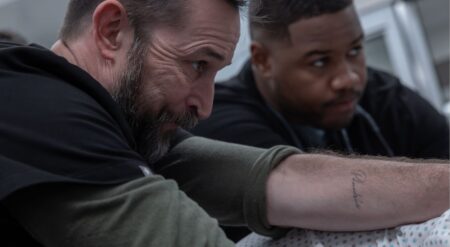
Sandro Rosta as Caleb Mir is at the center of tension in “Beta Test.”

That contrast mirrors the episode’s larger political stakes. Betazed’s return to the Federation isn’t treated as inevitable or even particularly desired. The Betazoids left after the Burn for reasons that still make sense, and Starfleet Academy Episode 2 respects that. This is not a Federation assuming it deserves loyalty; it’s one negotiating from a position of diminished authority. The analogy is unavoidable: this feels like a United Nations rebuilding after a collapse, not a superpower dictating terms.
Caleb Mir (Sandro Rosta), once again, sits at the center of that tension. His assignment to guide Tarima (Zoë Steiner), the Betazoid president’s daughter and a youth activist advocating for rejoining the Federation, is layered with irony. Caleb is the worst possible ambassador and, paradoxically, the most honest one Starfleet has. His motivations are personal, his wounds still open, and his understanding of consequence painfully limited. He isn’t sabotaging Starfleet out of malice. He simply doesn’t yet grasp the scope of what he represents.
Star Trek Starfleet Academy Episode 2 handles that flaw thoughtfully. Tarima’s anger when she realizes Caleb’s search for Goja V overlaps with his interest in her isn’t brushed aside or softened. Trust, once broken, doesn’t immediately reassemble itself just because intentions were complicated. That friction is the point. You can’t rebuild alliances without confronting how easily power can be abused, even unintentionally.
Caleb brings a new energy to the Star Trek franchise.

Caleb Mir works because he doesn’t resemble any familiar Starfleet trajectory. He isn’t chasing command, doesn’t believe in the institution yet, and has spent 15-years surviving in the margins the Federation failed to protect. Despite never having a formal education, he knows his way around systems, people, and technology because the galaxy forced him to learn. The long list of warrants across Ferengi, Orion, Trill, Andorian, and Cardassian space isn’t a joke. It’s proof that Caleb has lived everywhere Starfleet’s ideals didn’t quite reach.
What makes him compelling isn’t rebellion, but exhaustion. His life has been shaped by a single goal: finding his mother. Now that that pursuit is finally opening up, he’s left confronting a future he never planned for. That’s where his reluctance comes from. Leadership isn’t something he wants; it’s something that keeps finding him because he sees problems others are still learning to name.
Rosta’s performance keeps Caleb from turning dour. His humor lands because it feels defensive rather than performative, a way to navigate spaces he doesn’t yet trust. Chancellor Nahla Ake recognizes that immediately, defending him not because he’s exceptional, but because Starfleet needs leaders shaped outside the system as much as within it.
Holly Hunter is a strong anchor in Star Trek Starfleet Academy Episode 2.
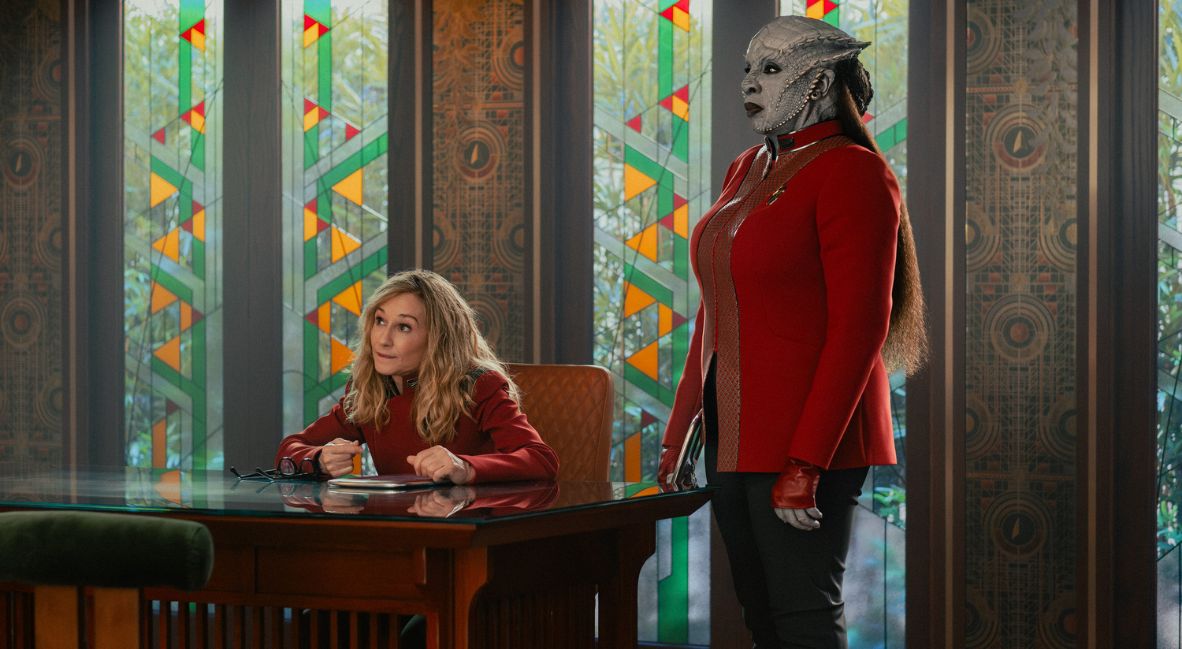
Chancellor Nahla Ake remains the episode’s quiet anchor. Holly Hunter continues to be exceptional, bringing a lived-in authority that never slips into self-importance. Ake isn’t trying to restore Starfleet’s image; she’s trying to change its posture.
Her proposal to relocate the Federation’s center of government to Betazed isn’t grandstanding. Instead, it’s an acknowledgment that Starfleet can no longer afford to center itself on Earth. That alone marks a meaningful philosophical shift for the franchise.
Visually and thematically, Starfleet Academy Episode 2 reinforces that idea. The Academy feels less like a monument and more like a worksite. The opening credits’ image of a seed growing out from Starfleet Academy lands especially well here. Growth, not dominance, is the organizing metaphor.
Even the abundance of Easter eggs, Boothby’s legacy, Kirk’s pavilion, and niche lines over the intercom feel less like nostalgia traps and more like reminders of a past that informs but doesn’t dictate the future. And come on, who doesn’t want to hear Stephen Colbert speaking Klingon in between classes?
The ambition is clear despite some growing pains.
With all of Starfleet Academy Episode 2‘s strengths, there are growing pains. With such a large ensemble, some character beats feel underdeveloped. SAM (Kerrice Brooks) being told she’s “taking up too much space” is a moment loaded with potential, but the episode doesn’t give that thread the room it deserves. It lingers as an afterthought rather than a fully explored conflict, and it would have benefited from either deeper focus or a later placement in the season.
Still, those issues don’t derail the episode. If anything, they highlight how ambitious the show is trying to be. “Beta Test” understands that this generation of cadets isn’t united by optimism or tradition. They’re united by inheritance. They didn’t create the broken world they’re living in, but they’re being asked to fix it anyway.
That’s what ultimately makes the Starfleet Academy Episode 2 work. This isn’t Earth trying to make Starfleet work again. It’s a collection of worlds, cultures, and young people trying to decide whether Starfleet is worth believing in and whether it’s willing to change enough to deserve them.
By the end of “Beta Test,” the series feels less like it’s finding its footing and more like it’s chosen its direction. There are still characters waiting in the wings, still relationships left underdeveloped, but the core is strong. Star Trek Starfleet Academy Episode 2 isn’t afraid of complexity, disagreement, or discomfort, and that’s exactly where Star Trek should be.
Star Trek: Starfleet Academy Episodes 1-10 are streaming now on Paramount+.
Previous Episode | Next Episode
Star Trek Starfleet Academy Episode 2
-
Rating - 8/108/10
TL;DR
Star Trek Starfleet Academy Episode 2 isn’t afraid of complexity, disagreement, or discomfort, and that’s exactly where Star Trek should be.