

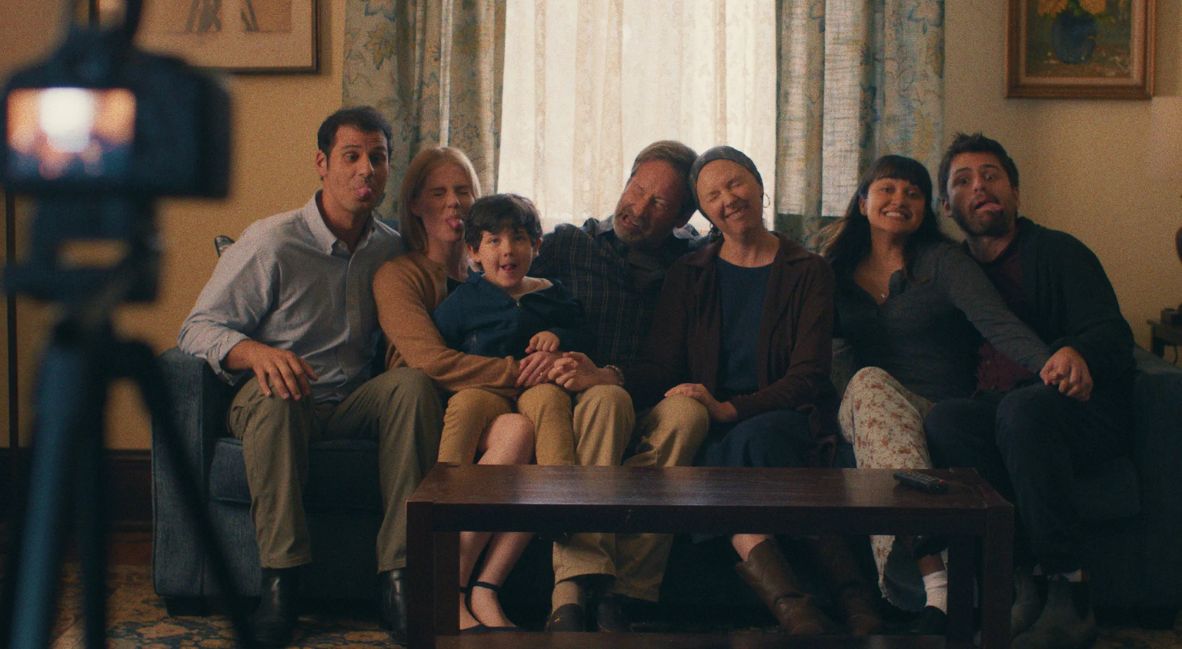
Directed by Jay Duplass and written by Adam Cayton-Holland, See You When I See You is a film that charts PTSD as it ripples through a family. Based on Cayton-Holland’s memoir Tragedy Plus Time: A Tragi-Comic Memoir, the film uses its endearing and grounded ensemble to capture the devastating impact of a suicide in one family, and the importance of meeting grief on its own terms.
See You When I See You is Jay Duplass’s return to the Sundance Film Festival. An adaptation of a personal memoir, the film strikes an important balance between moments of comedy and earnest depictions of deteriorating mental health with kindness. The film shows grief ripple through the Whistler family as they come to terms with the loss of Leah (Kaitlyn Dever), the youngest daughter.
Leah had a loud, vibrant life, and we meet her through the memories Aaron (Cooper Raiff), our main character, revisits. Aaron is a young writer whose identity has been Leah’s brother for his entire life. They were best friends who did everything together. They brought joy to each other, but they also served as crutches, propping up each other’s bad habits, always doing so with love.
However, now that Leah is gone, Aaron is alone, and he realizes just how much of Leah was a part of him. Music, bars, burritos, there isn’t a single thing that doesn’t remind Aaron about his little sister, only to have the memory fall apart, and leave Aaron staring at the void she left.
See You When I See You asks its audience to look at the devastating toll grief takes on mental health when all you do is layer humor over it. Aaron is in pain for much of the film, but where the audience sees him at his worst when alone, the others he interacts with don’t. He keeps his humor at the forefront of his life and conversations, but beneath the surface, he’s breaking more and more.
Grief is the antagonist of See You When I See You.
See You When I See You is a simple film that uses surrealist moments to depict Aaron’s memories becoming scattered as his trauma continually shatters every happy memory, injecting the moment he found his sister into almost every moment of his life. See You When I See You is hard to sit through. There isn’t anything graphic or abrasive, but the discomfort that builds as you watch Aaron head toward rock bottom is painful. Doubly so if you’ve ever been saved from the ledge.
See You When I See You isn’t about some grand resounding moment of healing. It’s about the small steps someone takes toward getting better, and the work it takes to get there. The film represents some of the most haunting representations of PTSD and most salient examples of recovery and therapy in cinema. Simple on the outside, the emotional depth that Jay Duplass captures guts you and restores you.
It’s easy to blame the person who committed suicide and map out the pain they leave behind. It’s increasingly harder to pull your audience through that pain and remove the shame and blame associated with it. As much as the film follows Aaron as he hits rock bottom and claws his way through grief, it’s also about him letting go of the blame he places on his little sister.
She didn’t lie about wanting to live; she didn’t do it to hurt him, and ultimately, it was just an unfortunate piece of life. Sad, but never shameful. See You When I See You is powerful in its simplicity and will leave you crying in your seat when the credits roll. Not because of the pain, but because of the hope.
Jay Duplass’s See You When I See You is one of the most grounded displays of PTSD on film.
Cooper Raiff’s performance is astounding. His pain resonates, and his choices bring sympathy. But, most importantly, Duplass and Cayton-Holland have created a film that shows that it isn’t just him. Sure, Aaron is using alcohol to numb his pain. Sure, he’s out of touch with what other people need; he only focuses on his grief. But he isn’t the only one.
His older sister, Emily (Lucy Boynton), is struggling to keep on task and settle Leah’s estate. She doesn’t get to cry or feel her pain; instead, she has to keep the family moving. Robert Whistler (David Duchovny) misses his daughter and takes every opportunity to tell someone else that he lost her. Robert is a patriarch, but his own familial struggles keep him from pushing Aaron to get help.
Then there is Page Whistler (Hope Davis). Like her son, she doesn’t want a funeral, and like her son, she just wants to ignore it all. Only, when she finds a lump, she has to decide if she can face the truth. But for her, she just doesn’t have it in her to fight, and finding out the test results could only spark more pain for the family.
Every choice the family makes seems to be in opposition to one another, but it’s all coming from the same need. The need to either remember Leah or to forget the moment she died. See You When I See You’s importance comes from how openly it discusses suicide, and its choice to show the grief as something terrible and all-consuming, and also as a vehicle to bring a family together.
Cooper Raiff’s performance is heartfelt in its devastation and its healing.
With stunningly grounded performances, Raiff leads the cast as a man who is performing for the world only to hide from everything else. He’s emotionally stunted and unaware of how to find joy without his best friend, without his little sister, who would change a club’s vibe from dour to electric. Aaron’s job is humor, but without Leah beside him, the world is without light.
While he does find hope with the girl he is dating (Ariela Barer), his self-centered grief doesn’t allow him to build anything lasting. He can’t make plans, he can’t tell her how he feels, and the alcohol continuously gets in the way, turning him into someone angry.
The growth Aaron undergoes in See You When I See You is about seeing the world around him as it is. It’s about him learning how to access his memories without the pain of her suicide injecting itself into them. The rockiness of that process is what makes the film stick with you and not feel like an after-school special about depression.
In the same way that See You When I See You doesn’t vilify Leah’s suicide, it also doesn’t cast Aaron as someone irredeemable. Instead, we see him as someone who can get better; he just needs to choose to.
See You When I See You captures hope and love, grief and pain, and does so with an earnestness that seeks to build a bridge between the audience and its characters, and, more importantly, the audience and those in their lives who may need help. Morseo, for me, it was like looking in a mirror at one of my lowest moments, and being told it was okay.
See You When I See You screened as a part of the 2026 Sundance Film Festival and doesn’t currently have distribution.
See You When I See You
-
Rating - 9/109/10
TL;DR
See You When I See You captures hope and love, grief and pain, and does so with an earnestness that seeks to build a bridge between the audience and its characters, and, more importantly, the audience and those in their lives who may need help.