

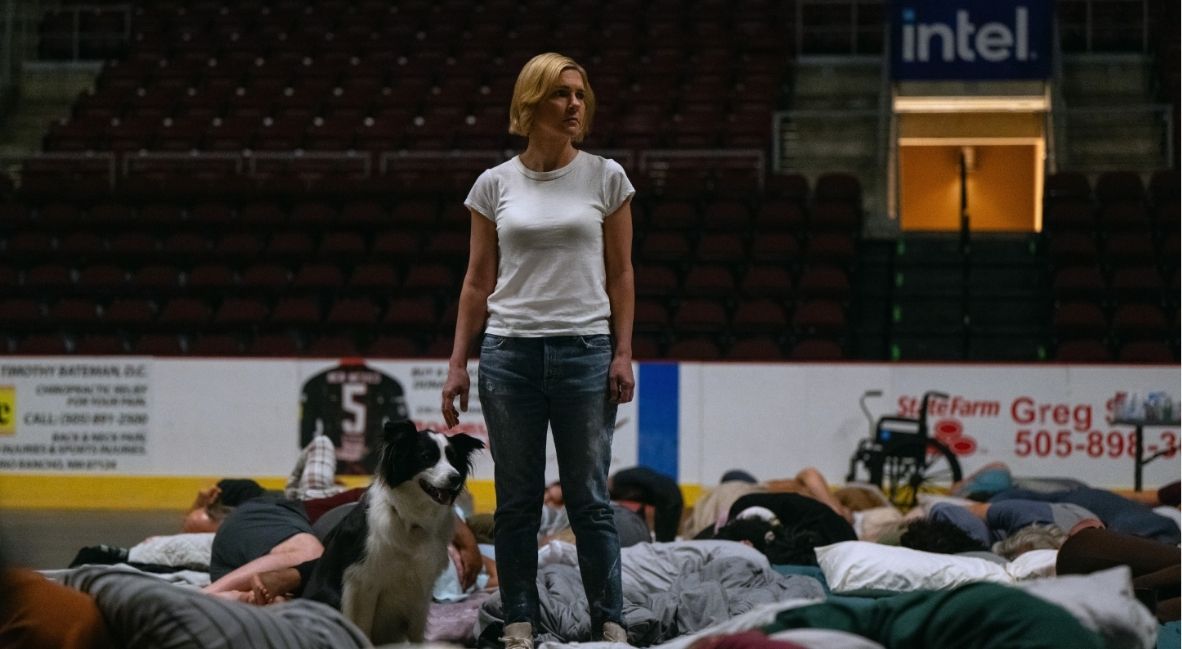
From its opening episodes, Pluribus makes it clear that the central problem isn’t aliens, technology, or even the end of violence. It’s interpretation. The show places a writer, Carol, who trusts her understanding of stories and human behavior, into a world that no longer responds to those assumptions. What follows isn’t a mystery to be solved, but the consequences of refusing to question the framework used to read it.
Early in Pluribus, Carol makes an offhand remark that quietly frames how she approaches everything that follows: “We’ve all seen this movie.” She treats what’s happening like a familiar science-fiction scenario, something that fits neatly into a genre she already understands.
Body snatchers, zombies, alien invasions; genres where the rules are known, and survival depends on figuring out the trick before it’s too late. It’s a defensive instinct, but also a revealing one. Carol assumes this story will behave like the science fiction she’s already consumed, confirming what she believes about humanity’s place in the universe. Vince Gilligan‘s Pluribus immediately starts pushing back on that assumption.
Instead of asking how humanity adapts, Pluribus questions the impulse to keep reaching past Earth.

Apple TV has built a deep bench of sci-fi that explores first contact, alien intelligence, and technological disruption from a wide range of angles. Across that slate, many stories are driven by how humanity responds when the rules of the world change, politically, technologically, or biologically, and what adaptation looks like in the face of something unfamiliar.
Pluribus approaches that same terrain and then quietly refuses the premise. It isn’t interested in whether humans can endure the future or rise to meet it. It’s more concerned with why the future is always framed as something to chase.
Instead of asking how humanity adapts, Pluribus asks whether the impulse to keep reaching past Earth, scaling up our technologies, and leaving consequences behind is the problem that never gets interrogated. That’s where Pluribus begins to feel anti-Star Trek, even if it never announces itself that way.
Pluibus doesn’t share Star Trek’s faith in humanity’s maturity or morality.
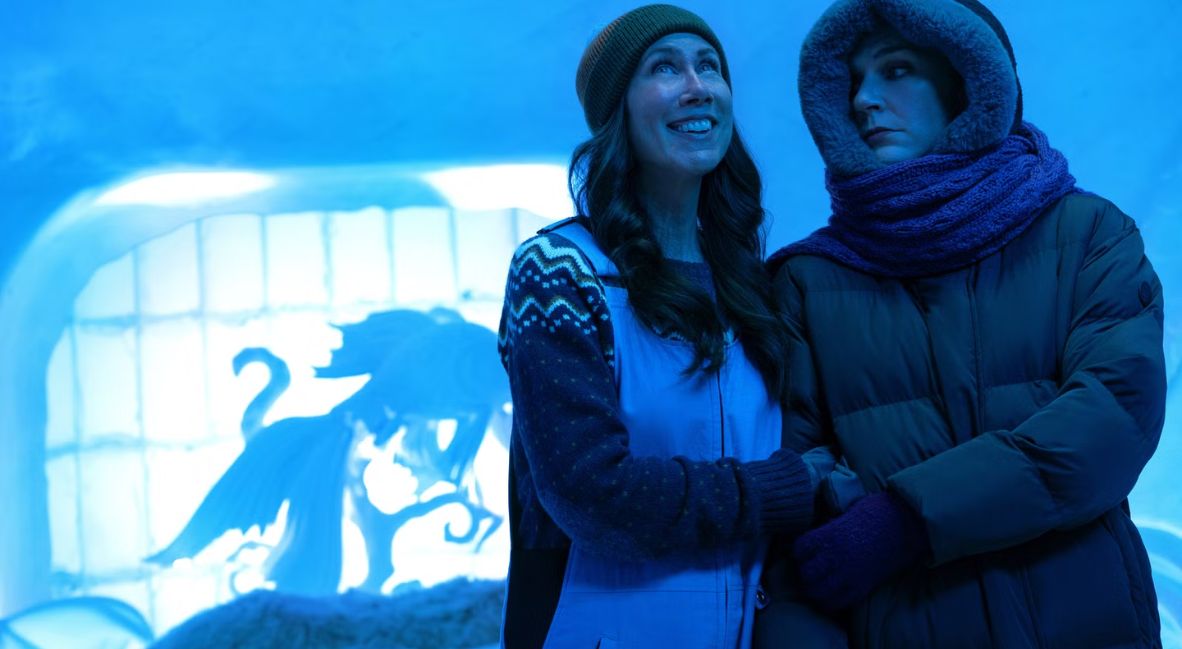
Star Trek is built on a promise that technological progress and moral progress move together. Warp becomes the signal that a civilization is ready to join something larger than itself, that it has earned the right to leave its planet and take part in a wider community. Even when things go wrong, the faith in that arc remains intact. Advancement is framed as growth, exploration as maturity, and expansion as a net good so long as it’s guided by the right values.
Pluribus doesn’t share that faith. It treats technological scale as a warning rather than a reward. The more capable humans become, the more tightly the show pulls viewers back toward the planet they’re already failing to care for. Instead of opening access to the stars, our advancement becomes the reason access is restricted.
We’re told the signal originates from impossibly far away, yet the Hive on Earth doesn’t even know who sent it. They also insist there are no aliens on Earth, a detail that quietly implies extraterrestrial life is already a known reality elsewhere. The show never stops to spell this out, largely because Carol never pushes past the answers that reinforce her fears. Still, the shape of the idea is clear.
Pluribus has no interest in the promise of a just future.

This isn’t first contact in the Star Trek sense. There’s no sense of mentorship, uplift, or a civilization waiting to welcome humanity into something larger. What unfolds in Pluribus feels closer to a protocol than a greeting: something triggered once a signal repeats long enough to be recognized, decoded, and acted upon. That framing changes the stakes entirely. The logic shifts away from moral judgment and toward containment.
The message isn’t “you are evil” or “you are unworthy.” It’s simpler and more unsettling: you can’t keep doing this. Expansion, colonization, and technological escalation have always displaced harm elsewhere. Strip mining, mass extinction, forced labor, and war are treated as acceptable costs, justified by the promise that they will eventually lead to something better, somewhere farther away. Pluribus has no interest in that promised future. It keeps its attention fixed on what expansion has already done, and on what happens when the ability to keep moving forward is quietly taken off the table.
That’s why ecology keeps creeping into Pluribus, whether viewers want to engage with it or not. The moment human dominance is disrupted, the planet responds immediately. Animals move freely. Noise recedes. Extraction slows. Systems begin to rebalance. None of this is framed as miraculous or moralistic. It’s presented as cause and effect, the predictable response of a system when sustained pressure is removed.
What if Earth doesn’t need to be shaped towards a better tomorrow?
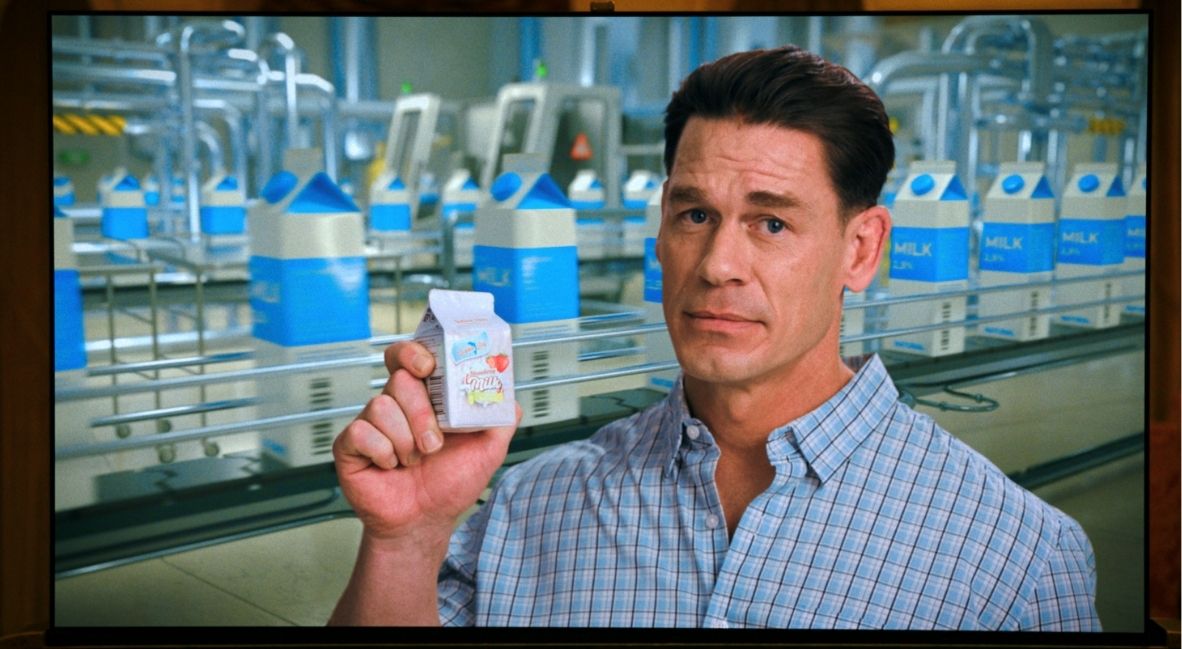
Carol reads that response as loss. She interprets the collapse of human control as something precious being taken away rather than as the accumulated consequence of what human control has always cost. That instinct shapes how she reacts to the Hive, to art, to animals, and to the land itself. If humans aren’t actively shaping the world, she assumes the world must be worse off.
Pluribus offers a different possibility. What if the planet doesn’t need to be shaped at all? What if technological readiness isn’t measured by how far you can reach, but by whether you’ve learned when to stop? This is where the show’s relationship to Star Trek becomes clearer and more complicated. Star Trek has always operated on the belief that technological progress and moral progress move together, even when that belief is tested.
Warp travel functions as a threshold, a signal that a species has reached a level of advancement that allows it to leave its planet and take part in something larger. The future it imagines is aspirational, built on the hope that humanity eventually learns from its mistakes.
Even Star Trek never fully escapes the ethical cost of space exploration.

But even Star Trek has never fully escaped the cost of that idea. Across its many iterations, the franchise repeatedly returns to civilizations that reach technological milestones without the ethical grounding to handle them. Innovation becomes leverage. Warp becomes weaponry.
Entire societies destabilize themselves by mistaking capability for readiness. Star Trek: Strange New Worlds makes this explicit, showing how breakthroughs meant for exploration are quickly repurposed for annihilation. Even within Star Trek’s optimism, readiness is fragile and often misread.
Pluribus pushes that tension further by asking a question Star Trek usually sidesteps. What if the harm required to reach the stars is itself disqualifying? What if the extraction, destruction, and extinction necessary to build that future matter more than the future they produce?
Even in moments of first contact, Star Trek rarely presents Earth as an uncomplicated success story. In First Contact, humanity’s survival depends on a post-apocalyptic recovery shaped by near-total collapse. In later eras, including those depicted around Star Trek: Starfleet Academy and post-Burn timelines.
Experimentation first, understanding later, consequences managed only after harm has already occurred.

Earth may be more stable, but the galaxy around it remains fractured, unequal, and shaped by conflicts that echo the same patterns of domination and resource control. Progress improves some conditions without undoing the damage done to get there.
Pluribus doesn’t argue that Star Trek is wrong. It questions whether the foundation has ever been stable enough to build on. The RNA sequence at the center of Pluribus sharpens that critique. Before it ever affected humans, it was tested on animals.
The pattern is familiar: experimentation first, understanding later, consequences managed only after harm has already occurred. This is not presented as villainy. It’s presented as routine. The same logic that has driven scientific advancement, industrialization, and expansion for centuries plays out again, only faster.
Seen this way, the signal doesn’t feel like an invitation or a warning. It feels like a pause. A prime directive to figure things out where you are, on the planet you already have, before you carry the same habits somewhere else. Whether the signal’s originators are caretakers, observers, conquerors, or something closer to long-running containment almost becomes beside the point. The outcome carries its own message.
What if we are the bison?

That message becomes even more complicated once the Hive turns its attention outward, preparing to transmit the signal again. The possibility opens in two directions at once. One follows familiar sci-fi logic: expansion, routes, repetition. The other is smaller and more unsettling: a system designed to intervene when a species begins damaging the environment it depends on for the sake of advancement.
Late into the season, Carol names that fear herself when she worries about the bison rubbing against paintings. But what if we are the bison? If we are not alone in the universe, then the version of humanity we bring with us matters. And even now, as technology accelerates faster than our collective understanding, the instinct to consume, conquer, and extract has not slowed. If anything, it has intensified, often guided by leadership with little ecological literacy or historical memory.
At best, Pluribus suggests humanity is being asked to grow inward before it grows outward. At worst, it implies that unchecked expansion always leads to futures closer to The Expanse than to Star Trek—worlds defined by scarcity, exploitation, and permanent damage rather than exploration and care.
By the time Carol says we’ve seen this movie before, the show has already told us why that instinct fails her. She keeps reaching for familiar stories that justify expansion instead of sitting with what this one is actually asking. In Pluribus, the frontier isn’t space but Earth, raising the question of whether humanity has earned the right to boldly leave it.
Pluribus Season One is streaming now on Apple TV.