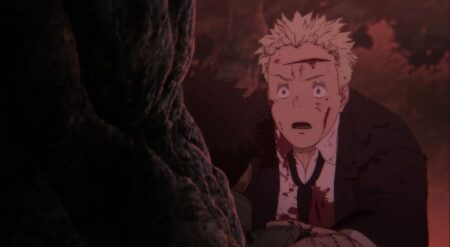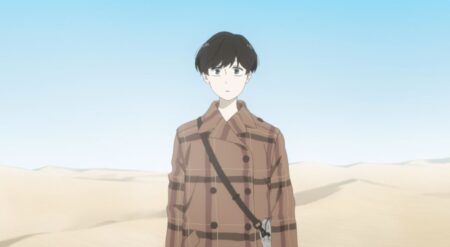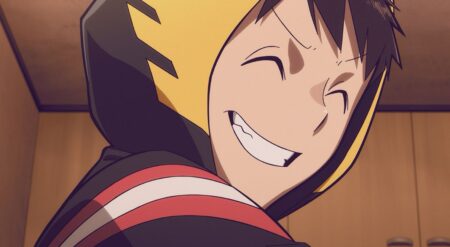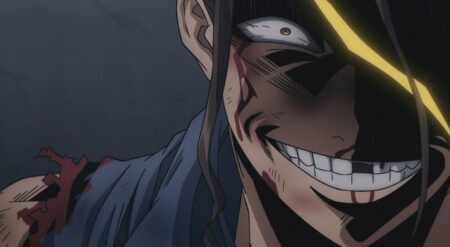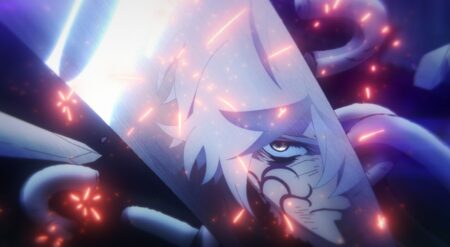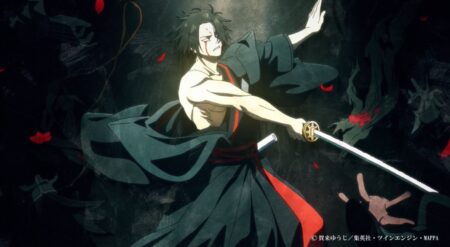

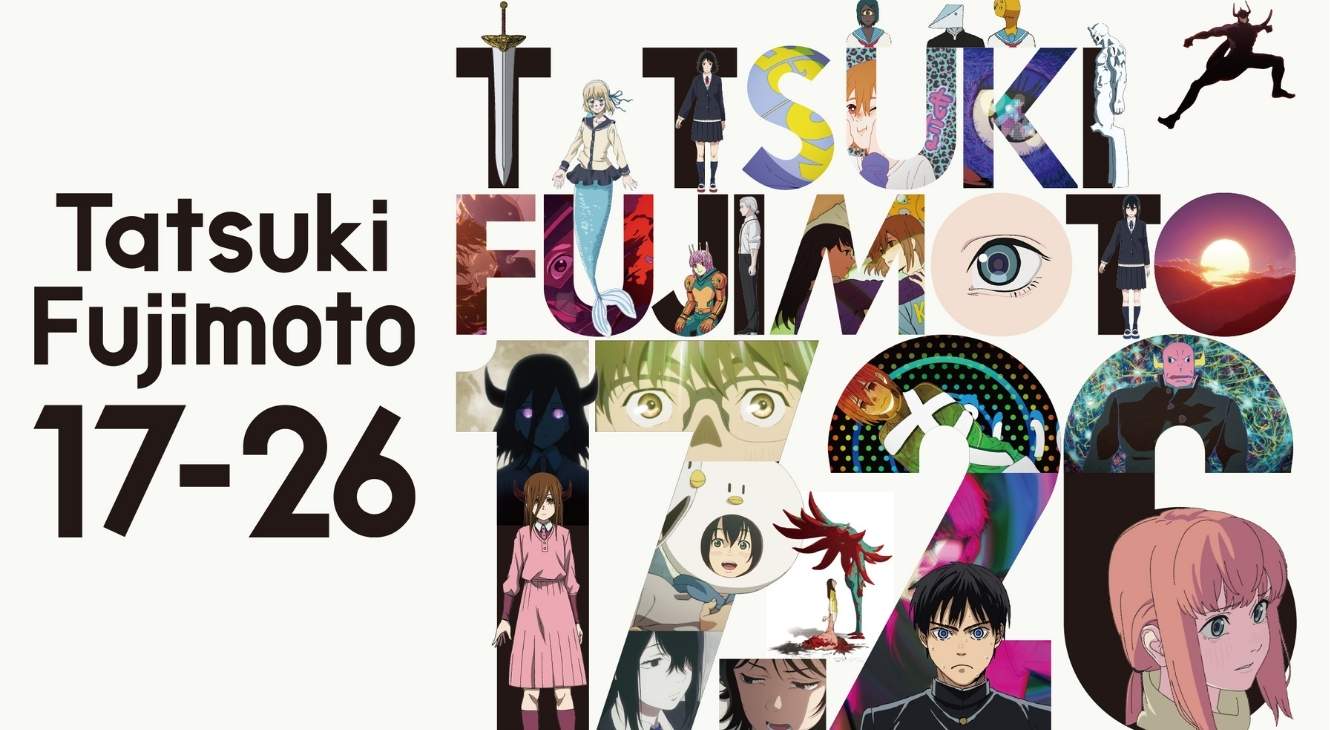
Tatsuki Fujimoto 17-26 is the anime adaptation of Tatsuki Fujimoto Before Chainsaw Man, an anthological collection of one-shot stories by the famous manga creator Tatsuki Fujimoto. The anime specifically adapts both volumes, 17-21 and 21-26. These are works the author created between the ages of 17 and 26.
While each one-shot is quite impressive in its own right, Tatsuki Fujimoto 17-26 enhances the already entertaining experience the source material provides. While not perfect, these stories clearly lay the foundations for the author’s bizarre yet excellent works, and each offers an engaging and unique viewing experience.
Tatsuki Fujimoto 17-26 Episode 1, “A Couple Clucking Chickens Were Still Kickin’ in the Schoolyard,” begins the collection on an incredibly bizarre note but also features some of the most emotional and impactful scenes in the collection. It takes place in a world where humans have been invaded, eradicated, and basically replaced by several alien species who now live on Earth, adopting human culture.
However, two young humans, Yuuto (Kenshô Ono) and Ami (Shion Sakurai), have evaded execution by disguising themselves as chickens in a schoolyard, and lucky for them, the aliens hate to eat chicken. Unfortunately, their safety doesn’t last long when a new alien transfers to the school from a planet where chickens are a delicacy, forcing the two on a desperate scramble for survival.
Tatsuki Fujimoto 17-26 starts with crazy energy, setting expectations from the jump.
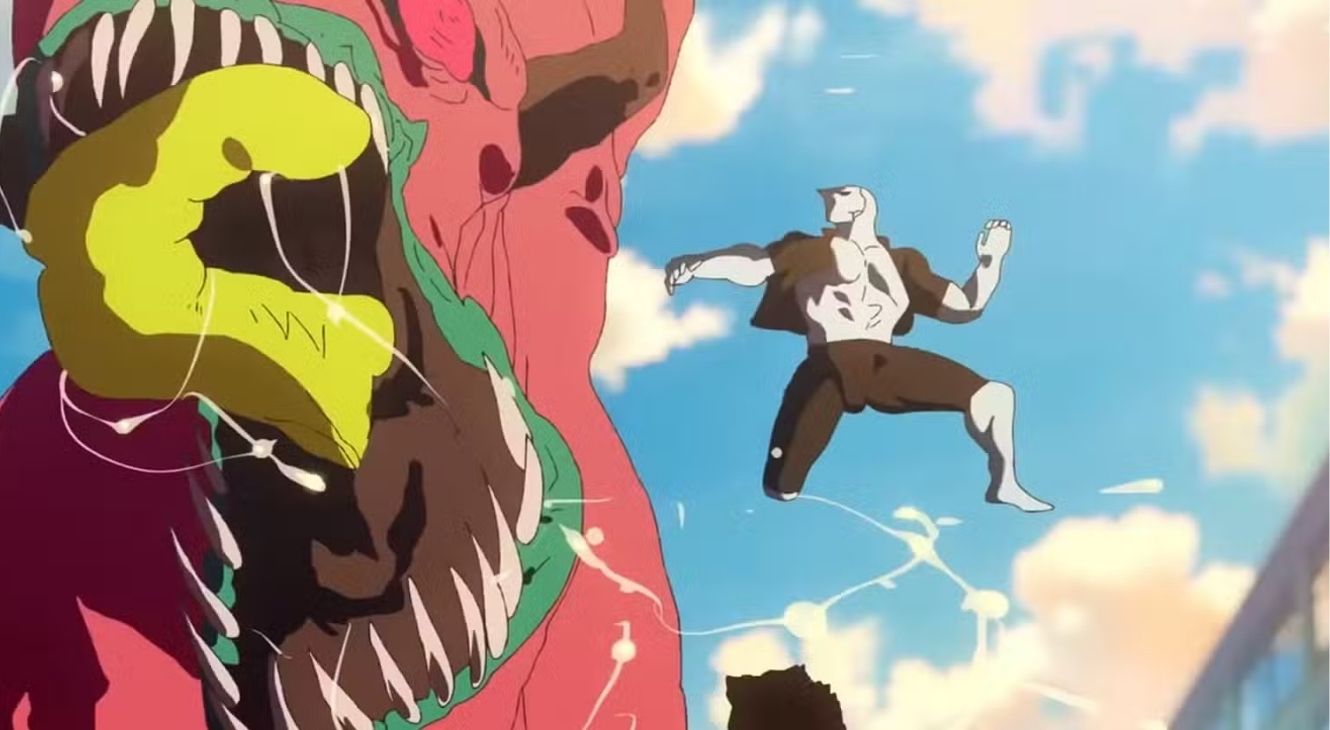
This episode succeeds in capturing viewers from the start, featuring twists and several heart-warming moments juxtaposed with brutal, gory, and gut-wrenching scenes. The final part of the episode, showing the quick and brutal killings of the humans in the initial invasion, was amazingly detailed, well-animated, and haunting. Like many of the author’s works, it explores some sad yet poignant themes, specifically the hope that emerges in times of turmoil.
Lastly, while several fights were animated superbly by Studio Zexcs and were all visually astounding, the direction, backgrounds, art direction, and character designs were the truly captivating parts of the production.
Tatsuki Fujimoto 17-26 Episode 2, “Sasaki Stopped a Bullet,” starts with a simple, condensed concept: a boy named Sasaki (Toshiki Kumagai) has a huge crush on his teacher, whom he oddly reveres as a god. However, this concept is quickly turned on its head with the twist of a shooter coming into the classroom to threaten the same teacher. Sasaki’s infatuation with his teacher leads him to standing up for her and even catching a bullet in his hands, but he is shockingly completely unharmed despite doing so.
What starts as a seemingly unassuming story about a boy’s infatuation with the only person who supports him turns into an interesting philosophical topic. As the episode progresses, more context is given, and it explores whether we can accomplish our goals or become better people if we simply believe in ourselves or believe we can. The episode’s animation and direction by Lapin Track aren’t flashy, and it is perhaps the least prettiest episode of the collection. However, its dialogue, narrative, and execution are fantastic.
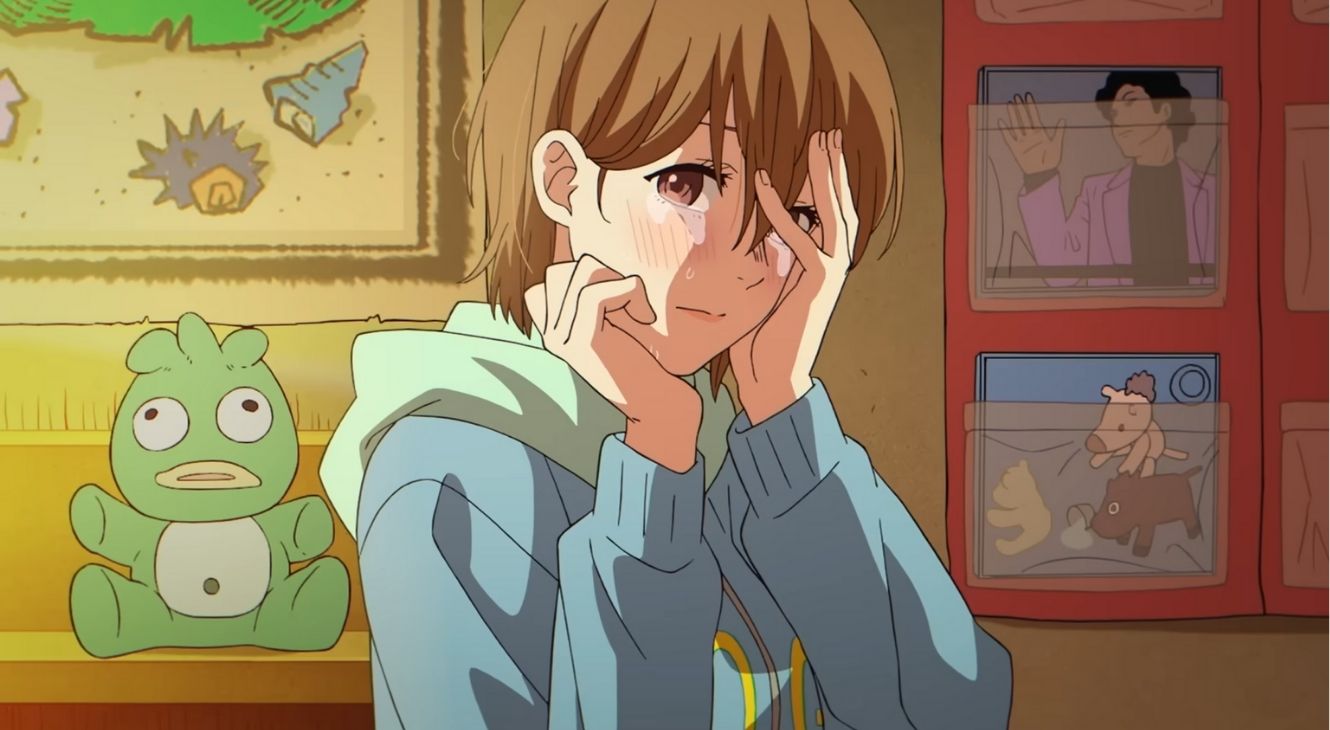
Tatsuki Fujimoto 17-26 Episode 3, “Love Is Blind,” is the simplest in concept, as it sees a teenage boy named Ibuki (Shun Horie) attempt to confess to his only fellow council member, Yuri (Shion Wakayama), who also clearly likes him back. However, he just can’t seem to bring the words out and get the right timing. He keeps getting interrupted by increasingly ridiculous things, such as his teacher trying to get him to stay in school later, a homeless man mugging them on their way home, and a literal potential alien invasion.
His sheer unwillingness to stop his confession, despite all these hurdles and every other character’s reaction to him, is what makes it one of the funniest episodes in the anthology. The humor is supported by wacky yet engaging and immaculately detailed and colourful visuals by Lapin Track, specifically the character designs and backgrounds.
Tatsuki Fujimoto 17-26 Episode 4, “Shikaku,” is the most high-octane episode of Tatsuki Fujimoto 17-26 and, like many of the author’s works, has a fantastical twist. The episode follows Shikaku (Kana Hanazawa), who is first introduced as a peculiar girl who lacks empathy and is obsessed with pulling off the legs of spiders. The first few minutes show her being brutally physically abused by her mother, who is revolted by her.
However, before we can learn more about Shikaku and her unfortunate family dynamic, the next scene skips forward in time. Shikaku is now older and a hired killer. She’s hired by a bored vampire named Yugel (Tomokazu Sugita), who has lived for too long and wants to be killed. After failing to kill him, she falls in love with him, and chaos ensues from then on.
Juggling between chaos and more stripped-down tales, Tatsuki Fujimoto 17-26 keeps viewers on their toes.
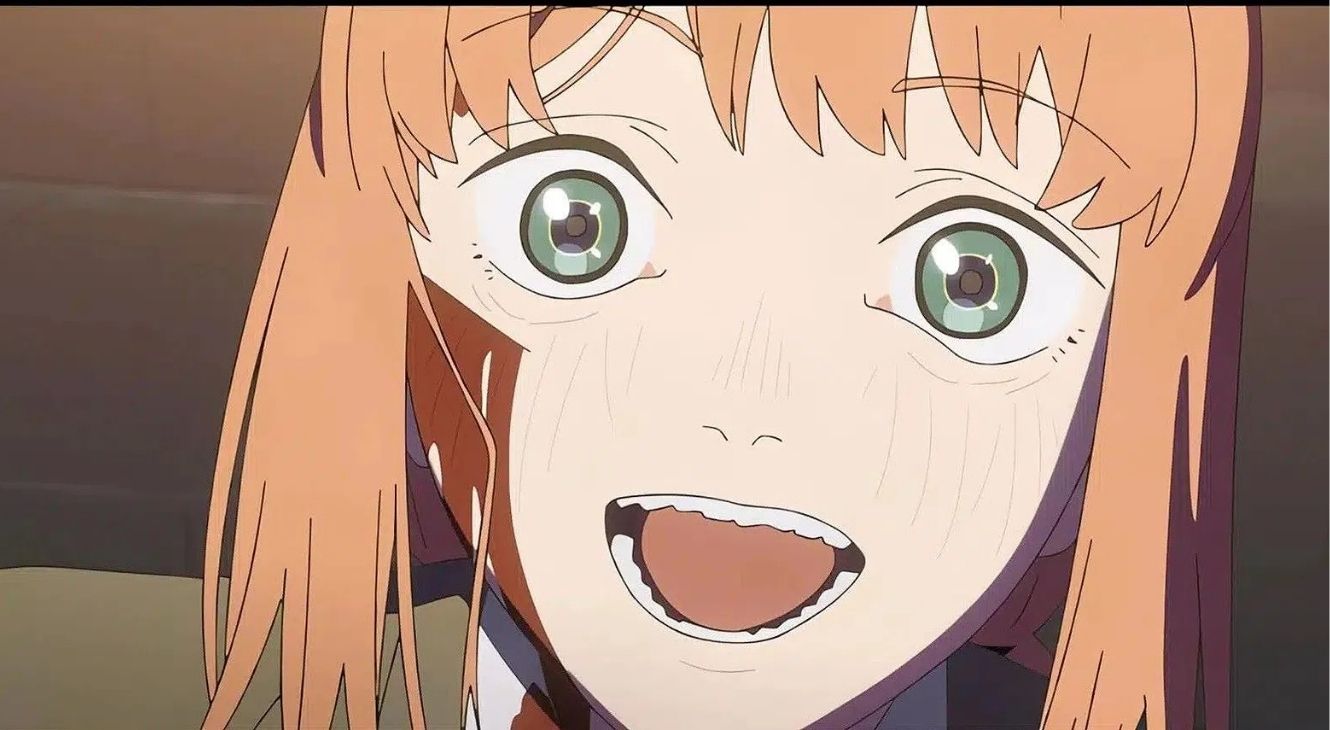
The story concept is quite simple, with the inclusion of a vampire being the only thing that makes it unique. However, the episode, like the rest of them, features several emotionally impactful moments, with the highlights being the brutal opening and the scene where Shizuka gets her ear blown off by bullets as she confesses her feelings to Yugel.
The episode also features some of the best animation in the anthology. It sports fluid motions by Studio Graph77, incredible art direction, vibrant backgrounds and many incredibly cinematic scenes. However, it also doesn’t feature any full-action scenes, despite being an action-oriented story. All the action is unfortunately inferred or happens off-screen, with only off-screen bullets and residual gore providing glimpses of the madness that would’ve otherwise enhanced the viewing experience.
Tatsuki Fujimoto 17-26 Episode 5, “Mermaid Rhapsody,” features no action or philosophical conundrums. It just features a simple story with a fantastical twist. It follows a young boy called Toshihide (Chiaki Kikuta), who recently lost his mom, and his dad is too heartbroken to care for him. He skips school and spends time playing a piano located at the bottom of the ocean, just like his mom did.
There, he meets a mermaid called Shiju, and he quickly falls for her. It’s then revealed that his mom was also a mermaid, and he’s essentially following the footsteps of his dad, as he tries to get closer to Shiju (Eri Yukimura) and the other mermaids despite the challenges and past between their two species.
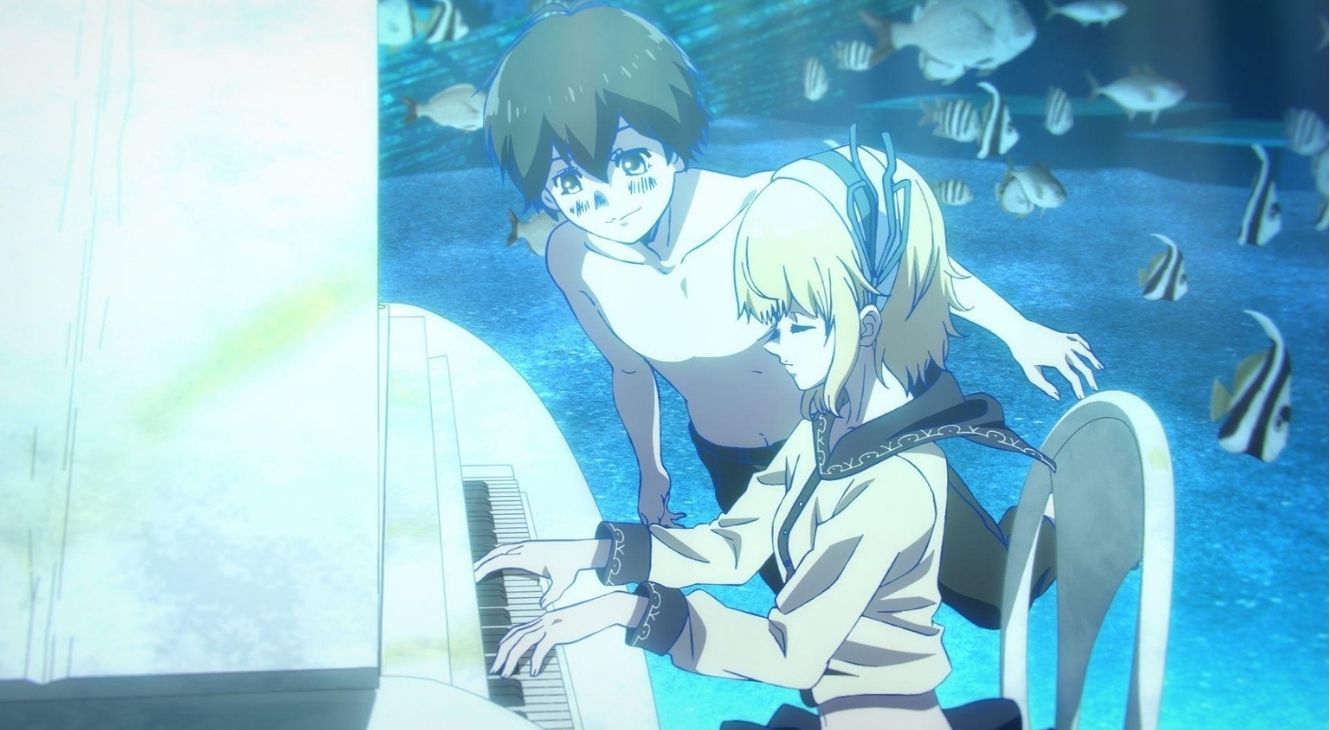
“Mermaid Rhapsody” depicts a story about acceptance despite differences. While the characters aren’t as endearing or interesting as those in other stories in the anthology, it still offers a nice, heartwarming story backed by picturesque visuals and amazing coastal art direction from 100studio.
Tatsuki Fujimoto 17-26 Episode 6, “Woke-Up-as-a-Girl Syndrome”, provides one of the funniest and bizarre stories in the collection. It follows a teenage boy, also oddly called Toshihide (Yuuki Sakakihara), who wakes up as a woman. He’s now forced to deal with his new incurable syndrome, getting attention he doesn’t want, and navigating his relationship with his girlfriend. The episode covers the theme of coming to terms with one’s own body and personality, but it is executed in a very unique and engaging way, not seen in the medium before.
The story, although brief and straightforward, was entertaining from start to finish thanks to its many wacky characters and their reactions to Toshihide, making it one of the strongest episodes in the collection. It’s also perhaps the best episode visually, as Studio Kafka knocked it out of the park with its use of vibrant colours, intricate facial animations, amazing art direction, and detailed character designs.
Tatsuki Fujimoto 17-26 Episode 7, “Nayuta of the Prophecy,” is perhaps the most thought-provoking and heart-warming episode. Set in a world of magic, it follows a girl called Nayuta (Hitomi Sasaki), who is born with demon horns and is prophesied to be the harbinger of the end times. Her mother died at birth, and her father was murdered by the hands of people who wished to see her dead.
The animation varies throughout, offering exciting visual takes on the source material.
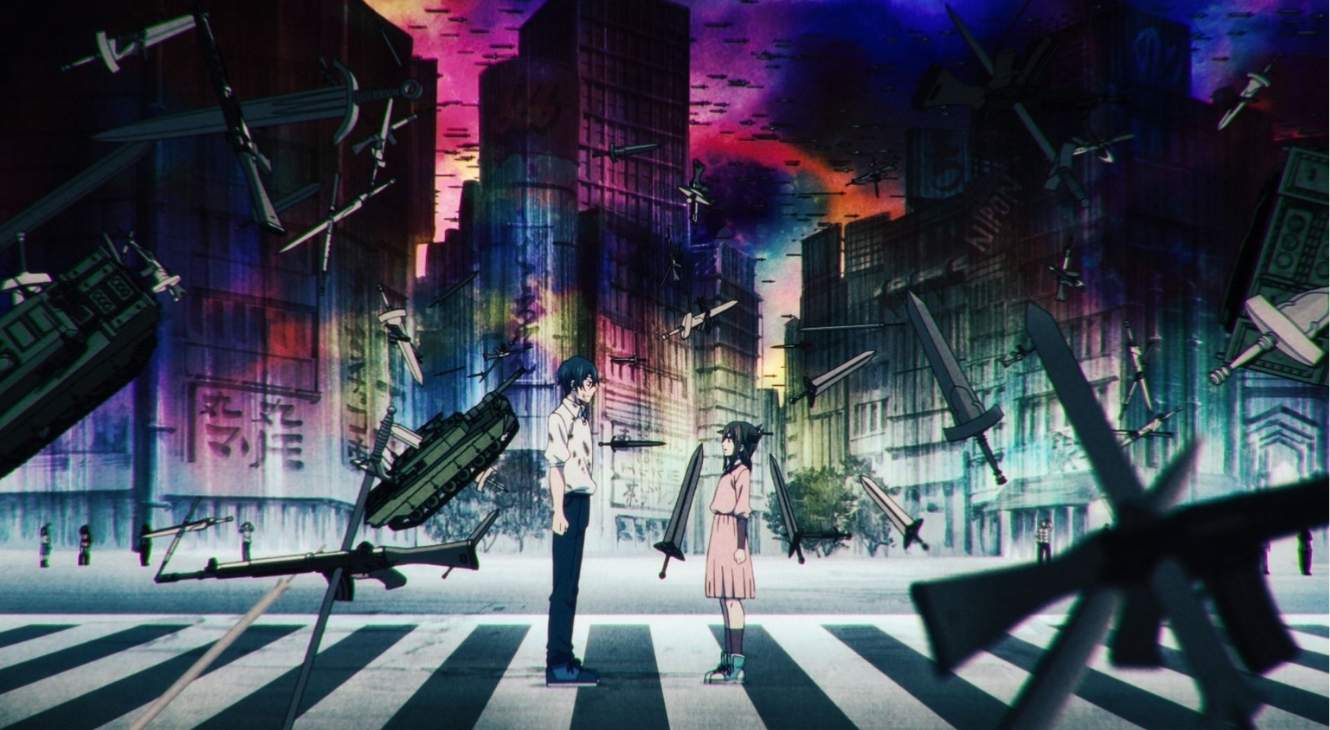
Despite this, her brother, Kenji (Yôhei Matsuoka), takes care of her through their many trials and tribulations. And despite not being able to communicate with her and her constantly killing animals and nearly ending humanity, he stays with her and supports her.
The story is quite touching in many ways and conveys a beautiful message about family and supporting one another, no matter what. Despite being brief, the concept and worldbuilding are executed wonderfully. They’re supported by amazing animation from 100studio, great voice acting, and a sublime soundtrack, making the episode one of the most memorable in the anthology.
Tatsuki Fujimoto 17-26, “Sisters,” continues the theme of family, focusing on the relationship between two sisters, Mitsuko (Runa Nakashima) and Kyouko (Tomo Nakai). The younger sister, Kyouko, always fawns over her older sister, and they’ve been inseparable for years, until high school, when Kyouko’s talent with art overshadows Mitsuko’s.
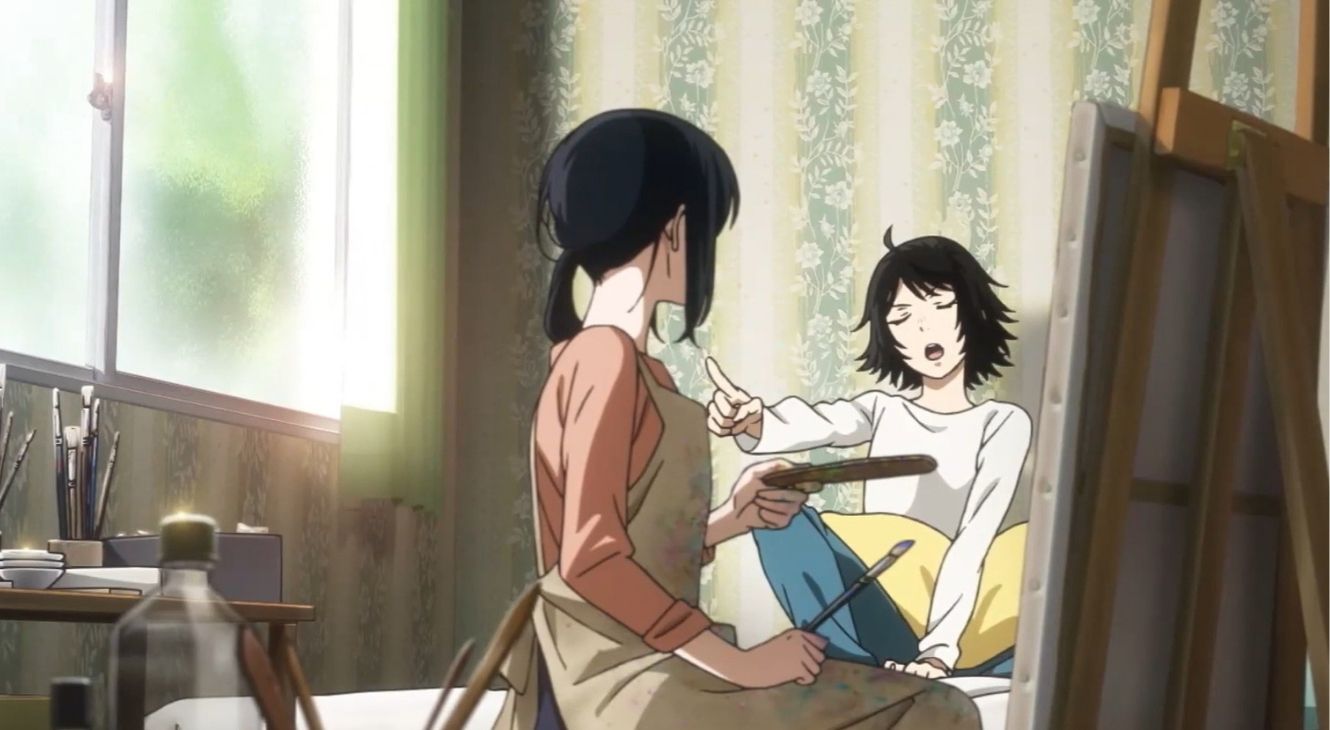
What starts out as Kyouko’s bizarre but humorous nude painting of Mitsuko, being hung up on the school’s wall after winning a contest, leads to Mitsuko vowing to outdo her younger sister with a similar painting of her own. “Sisters” depicts the weight of ambition and the feeling of an inferiority complex in a craft you are passionate about. It features numerous influences seen in Fujimoto’s subsequent one-shot, Look Back.
You can also tell he wrote this in his twenties, as it’s noticeably more refined than the others in many ways. “Sisters” is a simple story baked in realism but executed immaculately with amazing, detailed art, especially the paintings and backgrounds, and stellar direction from P.A. Works.
Every episode in the Tatsuki Fujimoto 17-26 anthology evokes a strong emotional reaction and is based on a central theme. Some episodes are as simple in concept, while others are more thought-provoking and philosophical. While some episodes flow seamlessly to the next, others, due to their shift in tone and theme, are more attention-grabbing and memorable.
Overall, Tatsuki Fujimoto 17-26 is a fantastic collection of some of Tatsuki Fujimoto’s wackiest but wonderful one-shots. Despite being some of his earlier works, surprisingly, none of the stories feel flawed or even half-baked, though some are notably better than others. The stellar anime adaptation enhances the stories in all the right ways.
Tatsuki Fujimoto 17-26 is streaming now on Amazon Prime Video.
Tatsuki Fujimoto 17-26
-
Rating - 8.5/108.5/10
TL:DR
Tatsuki Fujimoto 17-26 is a fantastic collection of some of Tatsuki Fujimoto’s wackiest but wonderful one-shots. Despite being some of his earlier works, surprisingly, none of the stories feel flawed or even half-baked, though some are notably better than others.