
When I saw the promos for Notturno, I was excited to see depictions of normal Middle Eastern and Levantine people living their lives, away from the harsh (and sometimes overemphasized) realities of current events. People in the countries filmed, including Kurdistan, Lebanon, Syria, and Iraq, have rich lives, experiences, and cultures completely outside of the trauma that Western audiences see portrayed all the time. It seemed as though Notturno, Gianfranco Rosi’s new documentary about Middle Eastern people living in tumultuous times, might offer a holistic view of these people who have long been seen as endless victims of countless conflicts. Unfortunately, Rosi is committed to keeping Middle Eastern people in this pigeonhole, giving viewers the most glancing pass at these people who deserve to tell so much more of their story.
Neo-Orientalism refers to the new Orientalist ways, how Western academics and commentators describe the Middle East and North African (MENA) region in the post-9/11 era. It is defined by seeing its conflicts contingent on “ancient disputes” between the people who lived there, with little to no acknowledgment of how Western influences changed the region’s dynamics. It is steeped in Islamophobia, presenting virtually all Muslims as “radicals” when most are normal people simply living their lives. Neo-Orientalism is present in so much of modern media portraying the Middle East. It is sorely detrimental to allowing MENA people to be represented in media as the three-dimensional people they are.
In its presentation of Kurds and Arabs in the countries mentioned above, Notturno reinforces these narratives, without nuance or a deeper understanding of who these people actually are as just that: people. Instead, everything is framed through how their words and actions related to the regional conflict. Obviously, the region has been through horrific wars and conflicts in the past decade, from various self-interested actions, but that’s not all it is. There is so much culture, both traditional and more modern, that the film ignores to present Middle Eastern people only through their trauma and despair. It’s a tiring trope that we see far too often in media about the region, even if it is a reality. And it is not our only reality, even for the people living in these war-torn areas.
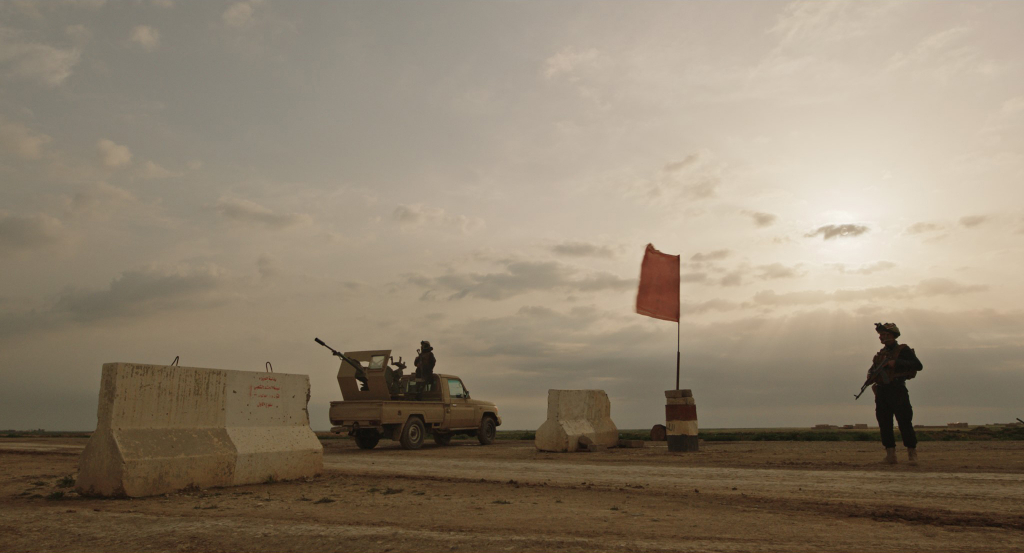
The film is mostly a stringing together of various landscapes and close-up shots from the region. The cinematography is overall beautiful. From beautiful deserts, grasslands, nighttime cities, villages, and more, the film does a rather good job presenting some of the region’s natural beauties. But it remains shallow in the presentation of the actual people who live there. There’s little to no exploration of their identities. We don’t even know their individual names. Ultimately, it feels like the only utility they have for this narrative is their trauma. It is obviously important and necessary for audiences to know what is happening in the region. Still, without that deeper exploration of the regional and societal dynamics, with actual interviews with the people, there’s barely any narrative that could give audiences a crucial understanding that is often ignored and downplayed.
There are a few good and important presentations of the people, however. In one of the first scenes, we see a Kurdish mother and her fellow women mourners grieve for her son killed by the Turkish military. Here, the filmmakers did a good job of conveying her grief and anguish, letting viewers understand some of the horrors that Kurds have faced from the Turkish state. Another good set of scenes occurs in the middle of the film when Yazidi and Kurdish children who were survivors of ISIS torture and abuse relay their experiences to a counselor. In the conversations between the children and her, we have an actual story being told about the horrors that ISIS (or “Daesh” as they are known) inflicted on the Yazidis, Kurds, Shia Muslims, and others. But the film goes out of its way to make these children’s’ experiences only about their trauma, without a substantive focus on their healing. The film presents their grief, not through a substantive documentary lens, but one of a passing glance, as though to say “oh those poor children” without even learning their names.
There is so much that could have been better with this film, with more substantive depictions and explorations of the Levant and its people. Unfortunately, Notturno mostly presents the people as though they’re figures in a zoo to be gawked at, without exploring their wants, desires, aspirations, cultures, music, or anything else that makes them relatable humans for the audience. Amazingly, it is a lazily made film for all its beautiful cinematography and efforts to get to these locations because it is clearly not interested in the substance, only the Neo-Orientalist image.
Ultimately, Notturno barely passes for a documentary and is mostly a seemingly random bundle of scenes from a depressing Middle East region sewn together. It serves to continue tired Western narratives about the Middle East with barely any substantive input from Middle Eastern people. It has some beautiful shots of country landscapes and a few scenes that relay real people’s grief, but it otherwise does not provide much understanding of who these people are. It’s such a shame, as all Middle Eastern people deserve to have their stories told without being put into a metaphorical trauma zoo.
You can watch Notturno streaming on Hulu on January 29th.
Notturno
-
Rating - 4/104/10
TL;DR
Ultimately, Notturno barely passes for a documentary and is mostly a seemingly random bundle of scenes from a depressing Middle East region sewn together. It serves to continue tired Western narratives about the Middle East with barely any substantive input from Middle Eastern people. It has some beautiful shots of country landscapes and a few scenes that relay real people’s grief, but it otherwise does not provide much understanding of who these people are. It’s such a shame, as all Middle Eastern people deserve to have their stories told without being put into a metaphorical trauma zoo.